
Traffic signals and signs are meant to guide, warn and regulate traffic flow. Town crews maintain existing signals and signs and install new ones when approved.
Many factors are considered when coordinating signs and signals, including the distance between signalized intersections, pedestrian traffic, on-street parking, traffic volume, speed limit, left-turning traffic, and collision history.
Report a concern
If you notice a traffic signal that's out or a street sign that's missing or damaged, please contact us.
Traffic and pedestrian signals
Traffic lights are programmed to optimize traffic flow based on time of day and day of week. Pedestrian crosswalks help pedestrians cross at intersections with traffic signals.
Pedestrian crossovers
A pedestrian crossover is a crossing that has:
- Specific signs
- Pavement markings
- Lights
Some have illuminated overhead lights, warning signs, and pedestrian push buttons. Crossovers are different from crosswalks because they're often at a stretch of road where there is no intersection.
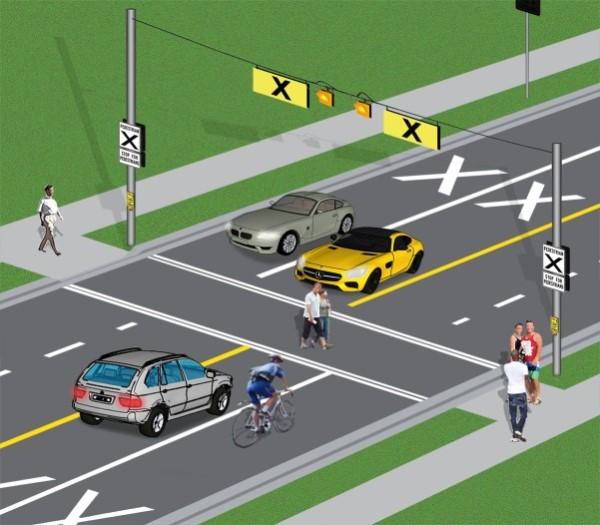
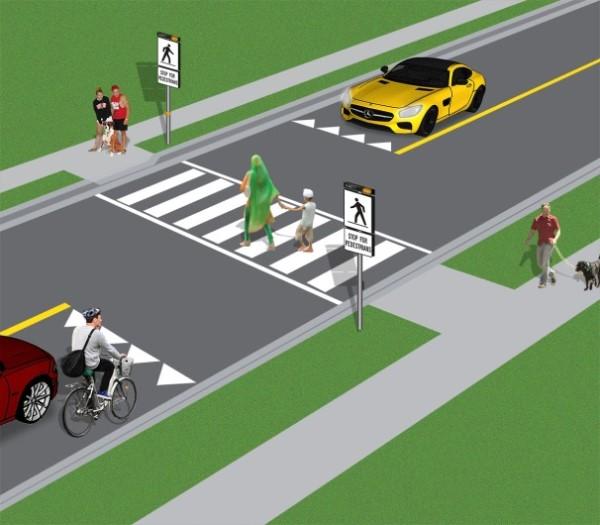
Pedestrians have the right of way at crossovers. Drivers and cyclists must stop behind the yield line and wait until the pedestrian completely crosses the road before proceeding. Learn the rules for pedestrian crossings.
Fines and penalties
There are three offences related to parking a vehicle within or near a crossover or crosswalk as per our Parking By-law:
- Within an intersection or crosswalk
- Within 30 metres of the approach side of a crosswalk that is not located at an intersection
- Within 15 metres of the departure side of a crosswalk that is not located at an intersection
The fines for all are $35 for voluntary payment (within 7 days) and $50 set fine (after 7 days). The Highway Traffic Act has additional penalties and fines. Review the Ministry of Transportation's Driver's Handbook for details.
Common signs
Disobeying traffic signs is prohibited by law, so remember to stay alert!
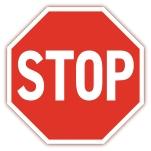
Stop sign
A Stop Sign regulates the flow of traffic between two relatively equal roads with similar traffic volume. Ontario-wide criteria are used to evaluate the need for stop sign installation, including traffic volumes, collision history, intersection sightline visibility, and road geometry.
Stop signs are not intended to be used as a speed control device. Stop signs installed in the wrong places for the wrong purpose usually create more problems than they solve. Extensive use tends to frustrate drivers, which may result in low stopping compliance and speeding between stop signs.
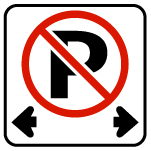
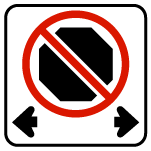
No stopping sign
A No Stopping Sign means you cannot stop your vehicle in this area, even for a moment. Drivers cannot drop off or pick up passengers here. You may receive a $120 fine under our Parking By-law if you do not obey the signs.
No parking sign
A No Parking Sign means that you cannot park your vehicle in this area. Drivers may stop their vehicle to drop off or pick up passengers, but they cannot leave their vehicle or wait for passengers while in a no-parking zone. You may receive a $35 fine under Parking By-law if you do not obey the signs.