
The spongy moth, previously referred to as European gypsy moth or by its scientific name of Lymantria dispar dispar (LDD), is a non-native invasive insect. Spongy moths feed on a variety of plants, preferring oak, birch, and aspen.
Spongy moth outbreaks in Ontario are cyclical, happening every seven to ten years, with peak infestations lasting 1 to 3 years.
How to identify the spongy moth
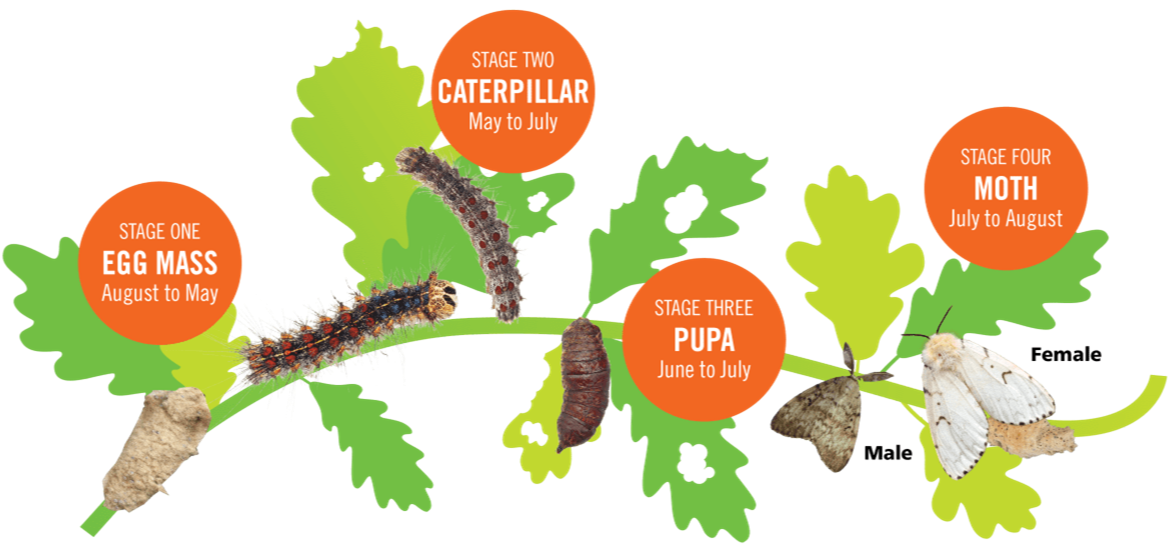
The spongy moth has four life stages:
- Egg mass: Egg masses are tan in colour, between the size of a dime and toonie. They are usually in tree bark crevices or other hidden places like vehicles, garbage cans, firewood piles, and outdoor furniture.
- Caterpillar: Caterpillars start off very small (about 2 mm). By the time they reach their last moult, caterpillars can be 5-6 cm long. They are dark and hairy, with blue and red dot pairs on the back.
- Pupa: At the end of the caterpillar stage, the larvae seek safe shelter to pupate.
- Adult moth: Male moths are light brown and slender-bodied, while females are white, heavy-bodied, and flightless.
Local impacts of the spongy moth
The last outbreak in Simcoe County began in 2019, with widespread defoliation in 2020 and 2021. The County of Simcoe's report on the spongy moth includes egg mass survey results and information on municipal decision-making.
Managing spongy moths at home
Keeping your trees healthy will minimize the impact of spongy moth defoliation stress. You can take a localized approach to manage spongy moths on your property. Control options depend on the spongy moth life stage and the time of year.
Learn how to protect trees on your property.