Town Hall will be closed on Wednesday, September 30 for National Day for Truth and Reconciliation.
Traffic Control and Safety
Traffic Control and Safety
Traffic control helps keep drivers, cyclists and pedestrians moving safely and efficiently throughout town. Traffic control includes speed limits, signals, signs, traffic calming measures, pedestrian crossings, and other strategies.
The safety of children is important to everyone in our community. Drivers should be extra vigilant when driving near schools to help keep our school zones safe for students, families, and pedestrians.
Parking restrictions in school zones help keep pedestrians safe and traffic flowing. These areas are marked with traffic signs. Disobeying traffic signs is prohibited by law, so remember to stay alert! Make sure your vehicle is not blocking a driveway or fire hydrant.
To help ease congestion in school zones, consider parking in a safe and legal space a few blocks from the school and walking the remainder of the way. Daily physical activity plays an important role in developing healthy kids and a healthier community overall!
People walking to school should be aware of the hazards posed by traffic and parking congestion. When walking:
Be seen, follow pedestrian safety signals, and be aware
Stop, look, and listen before crossing the road, even when it is your turn to cross
Make eye contact with drivers to ensure they see you before you proceed
Avoid distractions like texting, talking on your cellphone, and wearing headphones when crossing the street
Jaywalking can be dangerous; cross at pedestrian crossings
Benefits of walking to school
Active school travel brings many benefits to children, families and the overall community:
Walking or wheeling gives kids the chance to get to know their neighbourhood and develop confidence and independence
Walking or wheeling creates opportunities to learn valuable pedestrian and cycling skills
More students and families walking or wheeling to school makes it easier to see everyone and puts more eyes on the street for safety
Fewer cars around schools reduces traffic congestion, improves safety, and decreases harmful air pollution
Active school travel is an easy and fun way for families to reduce their carbon footprint, fight against climate change, and support a healthy environment
Parents and caregivers can role model healthy behaviours and benefit from the physical activity too
Here are a few simple actions that drivers can do to keep our community safe:
Look for pedestrians, especially when turning left or right. Don’t just look in front of you. Check the entire crosswalk for pedestrians and cyclists
Do not use handheld electronic devices (texting or talking) or other distractions such as eating and drinking when driving. Give the road your full attention
Be extra aware and follow slower speed limits in school zones and in neighbourhoods where children are present and sometimes unpredictable
Adjust your driving according to weather and traffic conditions
Never assume a pedestrian has seen you! Make eye contact and confirm with pedestrians that they know you’re yielding the right of way or turning
Speed limits
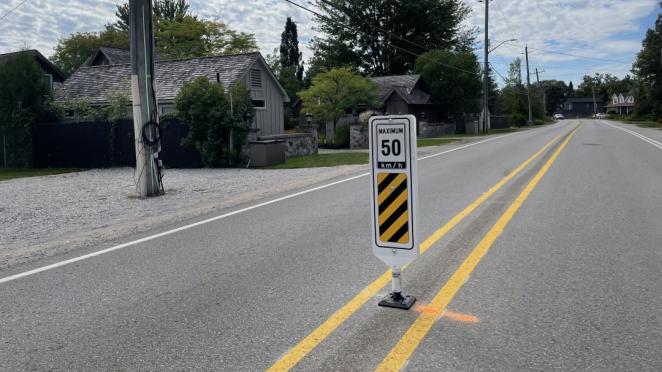
The Ontario Ministry of Transportation's Highway Traffic Act (HTA) sets a default speed limit of 50 km/h in built-up areas within our town. Under this legislation, we can set speed limits that range from 40 to 80 km/h in 10 km/h intervals.
The speed limit may be decreased in front of school zones, community safety zones, and construction zones. Please watch for signage and follow the posted speed limit.
Many factors influence speed limits. Some examples include:
Roadway design and classification
Vehicle operating speeds
Nearby development
Collision history
Pedestrian activity
Location of signalized intersections
Automated speed enforcement
Automated Speed Enforcement (ASE) is an automated system that uses a camera and a speed measurement device to enforce speed limits.
Innisfil's ASE program ended on November 14, 2025 following the adoption of Ontario's Bill 56, which repealed Ontario Regulation 398/19 – Automated Speed Enforcement. Penalties for speed infractions captured by ASE cameras prior to November 14, 2025 remain valid and must be paid.
Tickets are issued to the registered owner of the vehicle regardless of who was driving. For instructions on how to pay or dispute your fine, please see the back of the notice you received in the mail.
As with speeding tickets issued by police, the fine is based on the amount by which the driver exceeded the speed limit. Fines are listed in Schedule D Highway Traffic Act Speeding – Community Safety Zone. Fines are doubled in community safety zones, even if the violation occurred outside school hours.
How ASE works
When a vehicle exceeds a threshold speed over the posted speed limit, the Automated Speed Enforcement system captures an image of the vehicle and licence plate. Threshold speeds will not be disclosed.
A Provincial Offences Officer reviews the image before a ticket is issued. Once verified, the ticket is mailed to the registered plate holder at the address on file with the Province within 30 days of the offence. The ticket will include a digital copy of the image taken by the Automated Speed Enforcement camera and an enlargement of the licence plate, along with options for ticket payment or appeal.
Before their removal, Innisfil's cameras rotated through Community Safety Zones every few months. A Community Safety Zone is a designated area to identify it as a road segment of higher risk or concern. Many Community Safety Zones are located close to schools.
If you received a ticket, you can determine the camera location in the table below. “Municipal Speed Camera in Use" signs were installed when cameras were active and tickets were being issued.
When the program was operational, we used the funds to offset the costs of the ASE program (camera hardware and servicing, signage, processing fees, and other support expenses).
Any net revenue after expenses was transferred to a traffic and road safety reserve. These funds support initiatives related to traffic safety education, enforcement, and engineering measures such as signage, pavement markings, lights, etc.